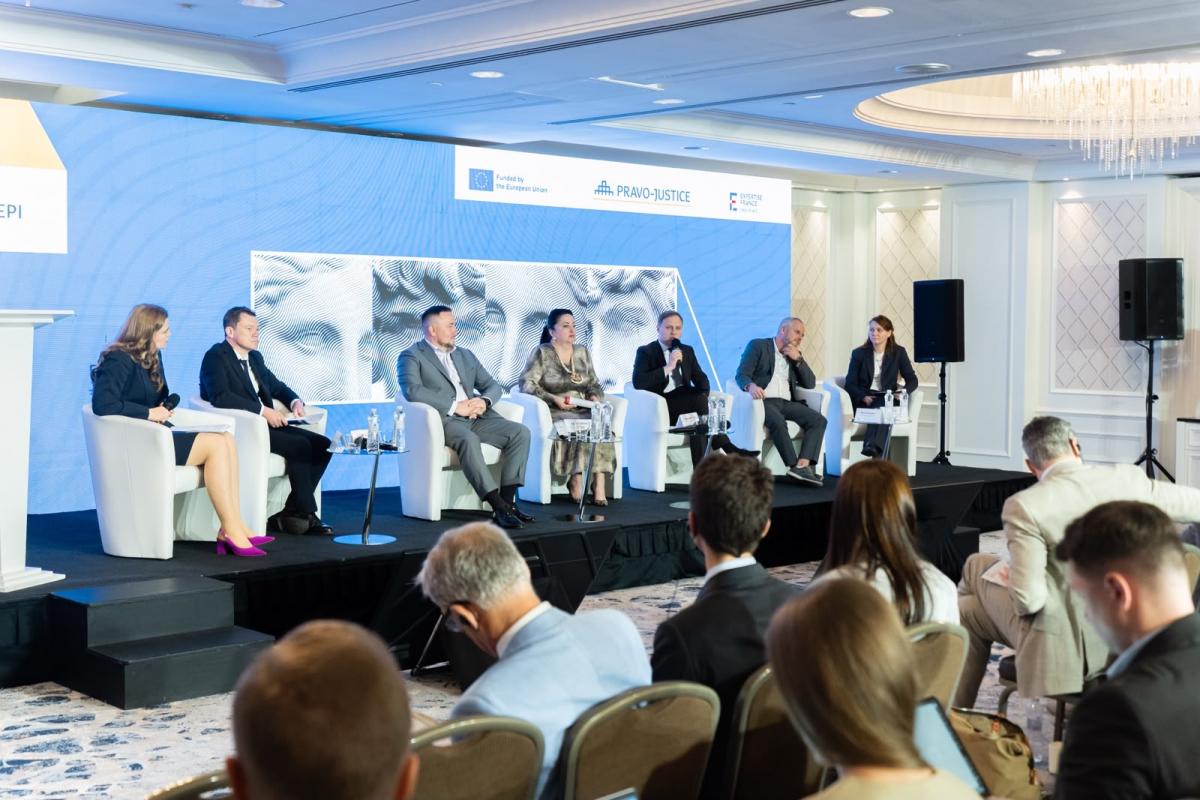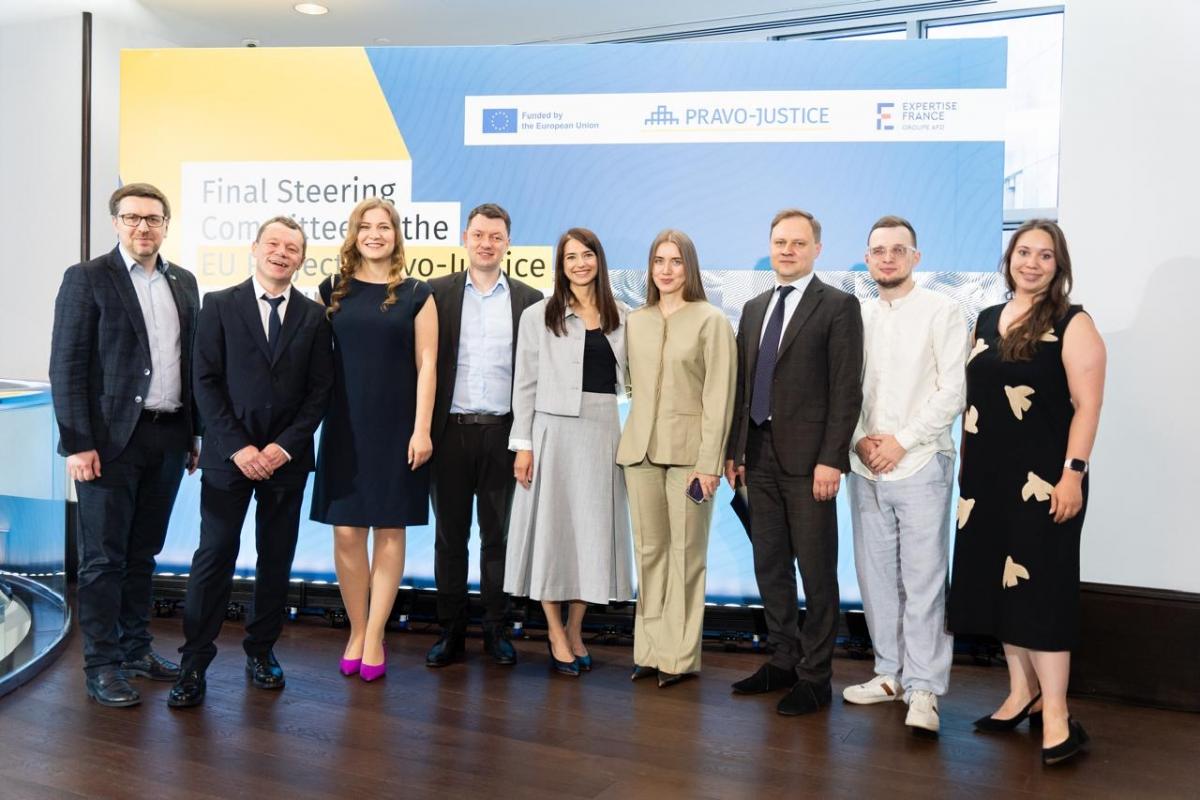

On June 18, 2026, Andrii Pasichnyk, the Chairman of the High Qualification Commission of Judges of Ukraine, participated in the final meeting of the Steering Committee of the EU Project “Support to Justice Sector Reforms in Ukraine (Pravo-Justice III)”.
The meeting reviewed the implementation of the third phase of the Project, presented the principal results of cooperation with Ukrainian public authorities and civil society organisations, and identified priority areas for future cooperation in line with Ukraine’s European integration agenda.
The participants were welcomed by Liudmyla Suhak, Acting Minister of Justice of Ukraine and Chair of the Steering Committee. She emphasised the significance and tangible results of the long-standing cooperation achieved during the third phase of the Project. According to Liudmyla Suhak, the Ministry of Justice of Ukraine, as the central institution responsible for coordinating the European integration process, has achieved substantial progress, including the development and subsequent implementation of the Rule of Law Roadmap. One of the clearest indicators of this effective cooperation was the official opening of accession negotiations under Cluster 1 “Fundamentals of the EU Accession Process”.
Sébastien Surun, Deputy Ambassador Extraordinary and Plenipotentiary of the French Republic to Ukraine, highlighted the comprehensive nature of the support provided by the Project to its Ukrainian beneficiaries. He noted that the Project’s expert assistance covered a broad range of areas, from promoting accountability for international crimes through the study and implementation of best practices to supporting judicial and prosecutorial reforms.
Asier Santillán Luzuriaga, Head of the European Integration, Governance and Rule of Law, Civil Society Section, EU Delegation to Ukraine, reviewed the Project’s key achievements in the context of Ukraine’s progress towards EU accession. He stressed that the Project had become an example of the effective combination of international technical assistance and national expertise. He noted that this support extends beyond technical assistance alone, enabling the practical needs of Ukrainian institutions to be translated into concrete solutions, knowledge and tools for the implementation of reforms.
Oksana Tsymbrivska, Team Leader of the EU Project “Pravo-Justice”, presented the principal results of the implementation of the Project’s third phase. She underlined that the Project’s mission is to strengthen the institutional capacity of Ukrainian public authorities to a level at which they are able to deliver key reforms independently and sustainably, without additional external support. Particular recognition was given to the cooperation with the High Qualification Commission of Judges of Ukraine, which is entrusted with a substantial workload relating to competitive selection procedures, qualification assessments and the formation of a professional judiciary.
Andrii Pasichnyk spoke during the panel discussion dedicated to judicial and prosecutorial reform. In his remarks, he emphasised that, for the Commission, cooperation with the EU Project “Pravo-Justice” has, above all, a practical dimension. Its value is measured not only by the number of activities organised but, more importantly, by the extent to which key procedures have been accelerated, strengthened and aligned with contemporary European standards.
The Chairman of the Commission noted that, following the restoration of the Commission’s operations in 2023, the HQCJ resumed its constitutional functions under conditions of a significant accumulated workload. The prolonged interruption of the Commission’s activities meant that it simultaneously faced the need to update its internal regulatory framework, relaunch statutory procedures and respond to the critical shortage of judges across the country. Following the resumption of its work, the Commission revised its internal regulatory acts and launched the implementation of key statutory procedures, including a large-scale selection process for candidates to local court judgeships and competitions for positions in appellate courts. These processes are unprecedented not only in terms of their scale but also in terms of the organisational and technical demands they require. Nearly 10,000 applicants participated in the selection process for local court judgeships, representing a record figure for Ukraine and an experience unique in its scale within the European context.
The organisation of procedures of this magnitude requires substantial logistical resources, robust IT infrastructure, reliable testing arrangements and the ability to ensure equal conditions for all participants. In this respect, the Project’s support, combined with the Commission’s own efforts, has made it possible to optimise individual stages of the selection process, strengthen the organisation of testing and improve the overall management of competitive recruitment procedures.
Andrii Pasichnyk also emphasised the importance of further digitalisation of the operational processes of judicial governance institutions as a prerequisite for strengthening institutional capacity, enhancing the transparency of procedures and bringing them into closer alignment with modern European standards. This includes, in particular, the development of specialised tools and digital modules for the collection, exchange and analysis of information capable of substantially simplifying the procedures for conducting background checks on judicial candidates.
With comprehensive support from the Project, the Commission will be able to move from the manual processing of large volumes of information to the automated generation of requests, receipt of information and analysis of data required for verifying judicial candidates and their close family members. This will have a direct impact on the efficiency, accuracy and transparency of judicial appointment procedures.
The High Qualification Commission of Judges of Ukraine highly values the contribution of the EU Project “Pravo-Justice” to strengthening the Commission’s institutional capacity and supporting the implementation of key judicial reform procedures. The consistency, professionalism and practical focus of this cooperation have become important factors in delivering the tasks essential to the continued renewal and strengthening of Ukraine’s judiciary.
For reference: the Steering Committee of the EU Project “Pravo-Justice” serves as a platform for strategic dialogue and coordination, bringing together representatives of public authorities, judicial governance bodies, justice sector institutions, international partners, civil society organisations and the expert community.
The Steering Committee’s work encompasses not only the assessment of results achieved but also the agreement of future support priorities, the identification of practical solutions for advancing reforms and the promotion of their alignment with European rule of law standards. This format enables the strategic vision of international partners to be combined with the practical needs of Ukrainian institutions responsible for implementing reforms in the justice sector.
A distinctive feature of the Steering Committee’s work is its partnership-based approach. The Project’s support is not provided as an externally imposed model of reform but rather as an instrument for strengthening the institutional capacity of Ukrainian authorities, promoting sustainable solutions and fostering shared ownership of reform outcomes. Consequently, meetings of the Steering Committee provide an important forum for open discussion of current challenges, assessment of the practical impact of implemented initiatives and identification of further steps in the context of Ukraine’s European integration.
The EU Project “Pravo-Justice” supports Ukraine in implementing justice sector reforms, strengthening the rule of law, enhancing the independence and efficiency of the judiciary, and aligning national institutional practices with the standards of the European Union.